Vimi: My Math Tutor
- 4.2
- Rating
- 100.00K
- Installs
- Free
- Price

 Analysis by App-foxy
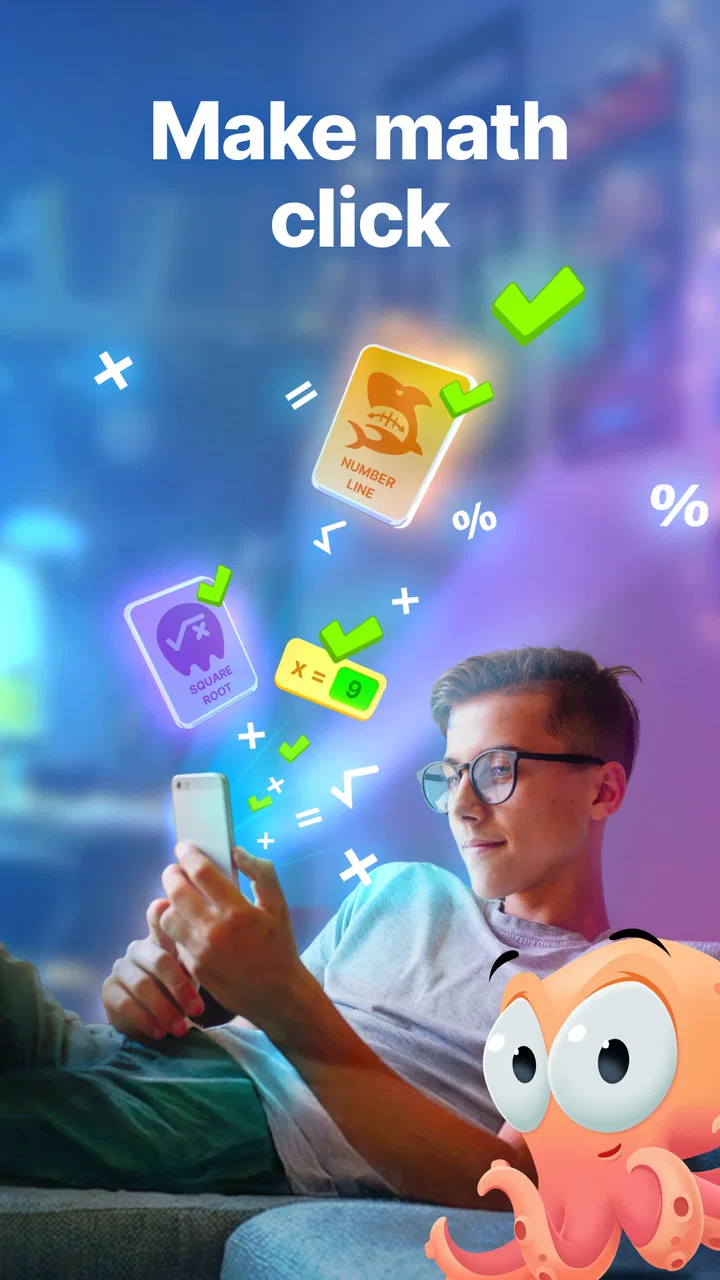
I spend a lot of time looking at study apps that promise to make difficult subjects feel less intimidating, so I approached Vimi: My Math Tutor (beta) with a practical question: does it genuinely help someone work through mathematics, or does it simply provide another place to look for quick answers? My experience is that it is most interesting as a guided learning companion rather than a replacement for a teacher, textbook, or carefully structured course.
Vimi is an education app from Vimi AI Math Tutor, designed around the idea of a personal AI tutor. It is available for free, which makes it easy to try without committing money at the start. The app is rated for Everyone, runs on Android 8.0 and later, and its current version is 1.0.41. Those details matter because the low entry barrier makes experimentation realistic for students, parents, and adults returning to math after a long break.
How Vimi fits into real math study
The useful way to think about Vimi is not as a digital worksheet collection. Its appeal comes from having a conversational helper available when a problem stops making sense. In a normal study session, that can be more convenient than searching through several videos or trying to match a textbook explanation to the exact point of confusion.
You May Also Like

 Blood Strike: 2.5 Anniversary
Blood Strike’s Loadouts Turn Every Drop Into a Tactical Gamble
A close look at Blood Strike’s custom loadouts: how fast access to signature weapons reshapes its battle royale rhythm, rewards preparation, and narrows the gap between fights.

 Pandora - Music & Podcasts
Pandora’s Music Is Easy to Start, but Harder to Recover
Pandora’s strength is its low-effort path from a seed to a station. Its weak spot is how much confidence it asks you to place in connection, setup, and quiet recovery.

 8 Ball Pool
 Is Built on Rivalries, Rematches, and Routine
A close look at the rivalries, rematches, shared routines, and unanswered safety questions that turn a quick pool match into a persistent mobile community.

 Samsung Music
’s Quiet Strength Is Playing What You Already Own
Its reach comes less from spectacle than from dependable access to a personal library. That simplicity is both the app’s strongest retention engine and its ceiling.

 AccuWeather: Weather Radar
AccuWeather Review: A Quick, Clear Forecast for Everyday Decisions
For everyday plans, the best forecast is the one you can understand quickly. AccuWeather makes rain timing, radar, and local conditions easy to act on, with a few trade-offs.

 Hill Climb Racing
Why Hill Climb Racing Still Turns Crashes Into One More Run
A tiny car, a bumpy hill and one more upgrade: Hill Climb Racing keeps resurfacing because its simple chaos makes every near-miss feel personal.
More From Our News Desk



I can imagine using it after school when a student understands the general topic but gets stuck halfway through an exercise. Instead of abandoning the page or copying a result from a search engine, the student can use the tutor to keep the reasoning moving. That change in workflow is important: the best outcome is not merely seeing an answer, but identifying where the method went wrong.
For an adult learner, the same arrangement is useful in a different way. Someone revisiting fractions, equations, or other foundational topics may feel uncomfortable asking another person to explain a basic step. A private tutor-style interaction lowers that social pressure. It does not remove the need to practise, but it can make starting less frustrating.
There is also a practical benefit for parents. Vimi can provide a first layer of help when a child asks about homework at a busy moment. I would still check the work rather than treating an AI explanation as automatically correct, but the app can help turn “I don’t know how to help” into a more focused conversation about the actual step causing trouble.
Free access makes the first decision simple
The app itself is free to install and try. That is the clearest value point here: you can find out whether the tutoring style suits your learning habits before spending anything. The store also lists in-app purchases ranging from $19.99 to $154.90 per item. Because those are paid options inside a free app, I would treat the free experience as the test phase and consider any purchase only after deciding that Vimi is becoming part of a regular study routine.
This distinction is worth keeping clear. “Free” means the initial access does not require a purchase; it does not mean every possible part of the experience has no cost. I would not buy immediately just because the idea of an AI math tutor sounds appealing. First, I would test whether explanations are understandable, whether the app handles the topics I actually need, and whether I return to it consistently.
The range between the lowest and highest listed purchase is substantial, so value depends heavily on what a particular paid item provides and how often the learner uses it. I would inspect the purchase screen carefully before confirming anything, especially if a parent is setting up the app for a child. The sensible approach is to judge the learning benefit, not the novelty of having an AI available.
What the experience is good at
Vimi’s strongest role is likely the “unstuck me” moment. Traditional search is often too broad: a student may find a long lesson when all they need is an explanation of one transition between lines. A calculator is even narrower because it can produce a result without teaching the method. A conversational tutor sits between those alternatives, offering a chance to ask for a simpler explanation or to approach the same idea from another angle.
That makes it especially useful for reviewing mistakes. I would use it after attempting a problem independently, not before. First write down the method, then ask for help with the exact point of uncertainty. This creates a useful comparison between your own reasoning and the explanation, while immediately asking for the answer can encourage passive copying.
A second, less obvious use is preparing questions for a human teacher. When a learner cannot describe what is confusing, the problem is difficult to solve efficiently. Working through the issue with Vimi can help identify whether the obstacle is vocabulary, a missing prerequisite, a sign error, or confusion about the order of operations. The resulting question for a teacher becomes much more precise.
A third use is short revision sessions. Many people avoid mathematics because they imagine needing a long, uninterrupted block of time. A tutor app can support a smaller routine: choose one topic, attempt one or two problems, explain the sticking point, and then write a similar example without assistance. That final independent attempt is the part I would not skip, because it shows whether the explanation actually stayed with you.
Where the usual alternatives still win
Vimi is not automatically better than every other way to learn. A well-written textbook is often stronger for a complete sequence of lessons because it presents definitions, examples, exercises, and progression in a deliberate order. A classroom teacher is better at noticing hesitation, adapting to a student’s broader history, and deciding when a learner needs to step back to an earlier concept.
Video lessons can also be preferable when the learner benefits from seeing a method demonstrated slowly from beginning to end. A dedicated calculator or symbolic tool may be better for checking arithmetic quickly, while a paper notebook remains better for building the habit of showing every step. Vimi’s advantage is flexibility at the moment of confusion, not total coverage of every learning style.
I would also be cautious with advanced or highly specialized mathematics. An AI explanation can sound confident even when a question is ambiguous or the learner has entered a problem incorrectly. For important coursework, exam preparation, or a topic where a small error can derail the entire solution, I would verify the reasoning with class notes, a teacher, or a trusted reference.
Tradeoffs to consider before paying
The first tradeoff is convenience versus discipline. Having help immediately available can reduce frustration, but it can also make it tempting to ask for solutions before making a serious attempt. Vimi is most valuable when used as a coach that reveals the next step, not as a shortcut that completes every exercise.
The second is personalization versus structure. A conversation can respond to the question in front of you, yet it may not create a complete study plan by itself. If you need a carefully ordered curriculum with a clear beginning and end, a conventional course may be a better foundation. I would use Vimi alongside a syllabus or textbook rather than expecting it to organize an entire academic year.
The third is free access versus paid value. The free starting point is attractive, but the listed in-app purchase range means the financial decision should come later, after real use. A learner who opens the app once a month is unlikely to receive the same value as someone who uses it several times a week to practise, review mistakes, and prepare questions. The price only makes sense in relation to that habit and to the specific paid option being considered.
There is also a beta-related consideration in the app’s name. I would expect a product in beta to feel like a work in progress, even if the basic idea is already useful. That means I would be patient with occasional rough edges and avoid depending on it as my only academic support. A beta app can be worthwhile for experimentation, but users who require a fully established learning system may prefer a more mature alternative.
Who is likely to get the most from it?
Vimi is a good match for students who understand explanations better through dialogue than through a static answer key. It also suits independent learners who are willing to attempt problems first and ask targeted questions afterward. The app’s Everyone age rating broadens its audience, but suitability still depends on the learner’s ability to judge explanations and practise independently.
It may be particularly helpful for someone who has a small number of recurring sticking points. For example, a learner who can follow most algebra work but repeatedly loses track when rearranging an equation may benefit from asking about that exact transition several times in different examples. The value comes from making the obstacle visible and then testing whether the learner can reproduce the method.
Parents may appreciate it as a supplementary tool, especially when they want their child to try another explanation before receiving direct help. I would frame it as supervised independence rather than an unattended homework solution. Asking the child to explain the result afterward is a simple way to check whether the app supported understanding.
On the other hand, I would skip Vimi as a primary solution if you need formal tutoring, guaranteed curriculum alignment, or detailed human feedback on written work. It is also not the right choice for someone who already knows they will use any answer-generating tool to avoid practice. In that case, a workbook with solutions at the back, a teacher, or a structured course may create healthier study habits.
A realistic way to use it during the week
Imagine a student arriving home with several algebra exercises and one answer that does not match the expected result. I would begin by copying the original problem into a notebook and marking the exact line where the reasoning changed. Then I would use Vimi to ask about that line rather than requesting a complete solution.
After reading the explanation, I would close the help and redo the original problem independently. If the result still differs, I would ask a narrower follow-up question, such as whether a sign was changed or whether the same operation was applied to both sides. Finally, I would create a similar problem with different values and solve it without assistance. This workflow turns the app into a feedback loop instead of a vending machine for answers.
For revision, I would keep a short list of mistakes that repeat. The next session could focus on only one pattern, such as confusing a rule or skipping a prerequisite step. That is a more productive use of an AI tutor than jumping randomly between unrelated questions. It also gives the learner a way to judge progress through fewer repeated errors, rather than through how quickly the app responds.
My verdict on the value
With a 4.5 average from around 204 ratings and more than 50,000 installs, Vimi has already attracted meaningful interest for a relatively focused education app. Those figures do not prove that it will suit every learner, but they do suggest that the concept is connecting with people who want accessible math help.
My recommendation is to start with the free access and judge it by one practical test: after using an explanation, can you solve a similar problem without help? If yes, the app is delivering learning value. If you only feel productive while the tutor is guiding every line, the benefit is weaker and a more structured teaching option may be better.
I would consider a paid option only for a learner who has established a regular routine and knows exactly what additional value they are buying. The listed purchase range makes casual spending difficult to justify, while consistent use could make a suitable option worthwhile. I would make that decision slowly, with the purchase details visible, rather than assuming that the most expensive choice is the most educational.
Overall, Vimi is worth trying for students and independent learners who want a private, conversational way to work through math confusion. I like its low-risk starting point and its potential to improve the moment between “I’m stuck” and “I understand the method.” I would not replace a teacher, textbook, or deliberate practice with it, but used carefully, Vimi can turn a frustrating homework pause into a useful learning session. That is enough for me to recommend trying the free version, while keeping expectations realistic about paid value and the limits of a beta AI tutor.
FAQs for Vimi: My Math Tutor
01What is Vimi: My Math Tutor (beta)?
Vimi: My Math Tutor (beta) is an educational app designed to help users improve their math skills. It offers interactive lessons, practice exercises, and personalized feedback. The app caters to various levels, from beginners to advanced learners, ensuring that users can tailor their learning experience according to their needs.
02What features does Vimi: My Math Tutor (beta) offer?
Vimi includes a variety of features such as step-by-step tutorials, interactive quizzes, and real-time feedback. It also provides progress tracking and adaptive learning paths to help users focus on areas that need improvement. The app's user-friendly interface makes it accessible for all ages.
03Is Vimi: My Math Tutor (beta) suitable for all age groups?
Yes, Vimi is designed to be suitable for a wide range of age groups. It offers content that caters to elementary, middle, and high school students, as well as adult learners looking to refresh their math skills. The app's adaptive learning system ensures relevance for all users.
04Are there any costs associated with using Vimi: My Math Tutor (beta)?
While Vimi: My Math Tutor (beta) offers a free version with basic features, there might be in-app purchases or subscription options for premium features. These could include advanced tutorials, additional practice exercises, and ad-free experiences. Check the app store for detailed pricing information.
05Can Vimi: My Math Tutor (beta) be used offline?
Currently, Vimi requires an internet connection to access its full range of features and updates. However, certain sections like downloaded lessons or exercises might be available offline. It’s best to check the app settings for specific offline capabilities and plan accordingly.
Pros
- Interactive and engaging learning modules.
- Customizable difficulty levels for all ages.
- Real-time feedback enhances learning.
- Gamified elements make math fun.
- Offline access for learning on the go.
Cons
- Beta version may have occasional bugs.
- Limited support for advanced math topics.
- Requires account setup for personalized features.
- In-app purchases for certain content.
- Interface can be overwhelming for beginners.

Vimi: My Math Tutor
Gallery